

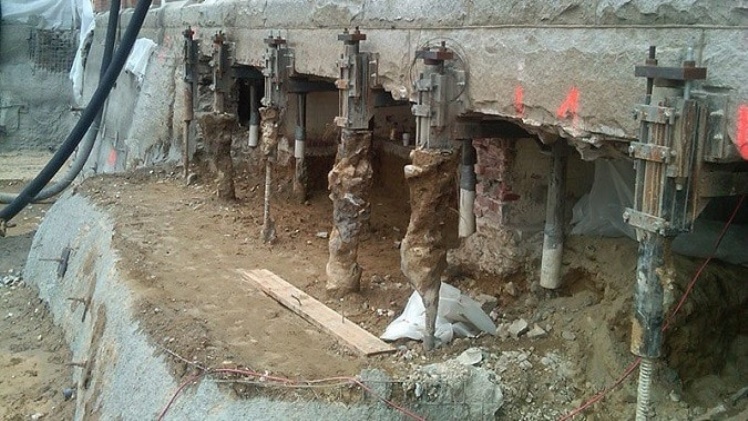
You’ve probably heard the term underpinning before in architectural contexts, and it likely sounded really complicated. If you ever wondered and searched for underpinning meaning then this post is for you! In this post, we break down what underpinning actually is and explain exactly how it works.
We’ll also tackle misconceptions about underpinning, go into detail about the different types of underpinnings you can use for your building project, and walk you through the process of undertaking an underpinning job from start to finish.
What is underpinning?
Underpinning is a method of protecting the foundations of a building from the effects of water, erosion and vibrations. It’s one of the most important steps in ensuring your building stands strong and tall over time.
It was originally used to provide protection against earthquakes in older buildings during the 1800s. Now, many developers choose to use underpinnings as a means of stopping water getting into cracks in existing buildings, which is a common problem among older homes.
Ground underpinnings are popular for their ability to withstand natural disasters, such as hurricanes and earthquakes. They are also used for homes that need additional insulation, or those that require extra support from the soil around them.
The most common reasons to undertake an underpinning project include:
- When the foundations of a building have been damaged by water, erosion or vibrations. Although it may not be immediately obvious, if these foundations are damaged, the building is also at risk of damage due to the effects of what are called ‘hidden movements’.
- Where additional support needs to be added to the foundations of a building in order to stop soil settlement and cracking.
This can occur due to different reasons such as; a soil type that’s prone to subsidence, seismic activity and more. This can also happen when there’s been significant changes on top of the ground where your building sits – for example, from roadworks or heavy construction projects.
Methods and materials
The methods and materials used for underpinning vary depending on the situation. In some instances, you can use the most basic form of underpinning, known as structural steel. This is popular amongst contractors who actively work in this field, but it requires a lot of preparation time before being used in your building project.
The majority of work using structural steel involves digging down at least 2 meters and placing a secondary steel beam straight down into the ground and connecting it with the one beneath it. This is then filled with concrete and serves as a buttress for support.
In most cases, this form of underpinning takes at least 4 weeks to complete and incurs very high costs. It’s generally only suitable for use on new buildings or in smaller scale redevelopment projects.
Other forms of underpinning include the use of steel piles and timber piles, where steel or timber beams are inserted into the ground in order to stop foundations from being impacted by soil movements. These methods are commonly used in densely populated areas, due to their speed and cost effectiveness.
The best approach will ultimately depend on what your building looks like, how much money you want to spend and other factors to consider before undertaking the project.
Underpinning misconceptions and more
Underpinning really is a great thing to do for any building, as it provides much needed additional support for foundations. As we explained earlier though, the methods you can use are dependent on your situation and in many cases, cost considerable amounts of money. You may even have to pay extra for structural steel underpinnings if this is a must-have when it comes to your building project.
Bottom line
In this post, we break down the different types of underpinnings that you can use for your building project. Each one is designed to cope with particular needs in certain cases and provide a solution for different foundations. For example, if your building rests on a steep ground floor (e.g. a flat roof), then timber piles may be the ideal choice to place underneath your building as they’re very cost effective and can be quickly installed when required.
