

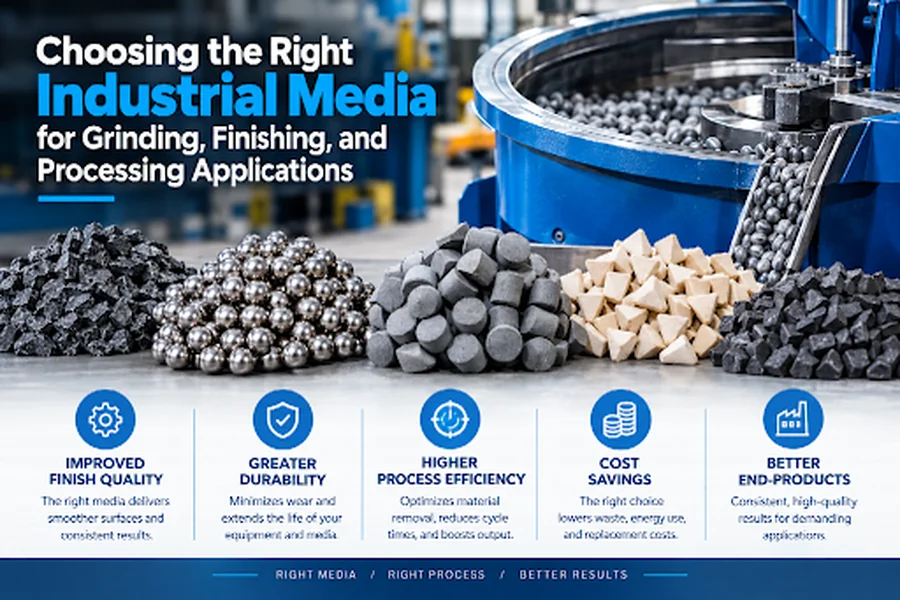
Industrial media plays an important role in manufacturing, mineral processing, chemical production, and metal finishing. Although media may represent only one part of a larger processing system, its properties can directly affect efficiency, product consistency, equipment wear, and operating costs.
The challenge is that different applications require different types of media. Material used to reduce particle size is not necessarily appropriate for polishing a metal component, while media used in a chemical reactor has entirely different performance requirements.
Understanding the differences can help manufacturers make better decisions when selecting media for their processes.
Understanding Industrial Media Selection
Choosing the right media starts with understanding the job it needs to perform.
In milling applications, media transfers mechanical energy into the material through impact, compression, and abrasion. This helps reduce particle size and break down the material. In finishing applications, media repeatedly contacts manufactured components to remove burrs, smooth edges, clean surfaces, and achieve the required finish.
The properties of industrial milling media can have a significant effect on processing results. Key factors to consider include:
- Hardness
- Density
- Size
- Shape
- Wear resistance
- Chemical compatibility
- Thermal stability
- Risk of contamination
The right choice depends on the material being processed, the equipment being used, the operating conditions, and the desired outcome. A media specification that works well for one application may not be suitable for another.
How Grinding Media Affects Particle Size and Process Efficiency
Grinding media plays an important role in how efficiently a mill reduces material to the desired particle size. During operation, the media is subjected to repeated impact and abrasion as it transfers energy throughout the mill.
The type of grinding media used can affect both the speed of size reduction and the resulting particle-size distribution.
Media Size
Media size affects how energy is delivered during the grinding process. Larger media generally produce greater impact forces, while smaller media provide more contact points and can be better suited to finer grinding.
Media Density
The density of the media affects the energy generated during each collision. The appropriate density depends on factors such as the material being processed and the design and operating conditions of the mill.
Hardness and Wear
Grinding media should typically be harder than the material being processed to maintain effective grinding. Excessive wear, however, can shorten media life, increase replacement costs, and introduce unwanted material into the finished product.
Material Compatibility
Media composition should also be compatible with the material being processed. This is particularly important when even small amounts of contamination could affect product quality.
The objective is to select media that provides the required grinding performance while maintaining acceptable wear, product quality, media life, and operating costs.
When Tumbling Media Is the Better Choice
Not every manufacturing application requires particle-size reduction. When the objective is to improve the surface or edges of manufactured components, tumbling can provide a more appropriate solution.
Tumbling media is commonly used in processes such as:
- Deburring
- Polishing
- Burnishing
- Cleaning
- Edge rounding
- Surface finishing
During a tumbling operation, components and media are placed inside a rotary or vibratory finishing system. Movement causes the media to repeatedly contact the workpieces.
The result depends heavily on the media selected. Size, shape, composition, and hardness can all affect how the media interacts with the component.
For example, media that is too large may struggle to reach narrow areas, while media that is too small may not provide the required finishing action efficiently.
Media Selection for Reactor and Catalyst Applications
Industrial media also has an important role outside traditional manufacturing and finishing processes.
In chemical and petrochemical facilities, ceramic materials can be used as support media within reactor systems. These applications require a completely different approach to media selection.
A catalyst bed must remain mechanically stable while allowing gases or liquids to pass through the reactor. Support media can help protect catalyst material and provide structural stability within the bed.
Important characteristics can include:
- High mechanical strength
- Chemical resistance
- Thermal stability
- Resistance to attrition
- Appropriate geometry
- Consistent physical properties
Alumina and silica-alumina ceramics can be suitable for demanding environments because of their ability to withstand challenging chemical and thermal conditions.
For these applications, engineers need to consider more than simply media durability. Fluid distribution, pressure drop, catalyst protection, and long-term bed stability can all influence the selection.
Selecting Stainless Steel Media for Demanding Finishing Applications
Metal finishing can involve thousands of repeated cycles, making media durability an important consideration.
Stainless steel tumbling media is particularly useful in applications where corrosion resistance and long service life are important.
Stainless steel media can be produced in different shapes and sizes, allowing manufacturers to match the media to the geometry of the components being processed.
For example, smaller pieces may be useful for reaching recessed areas, while larger shapes can provide more substantial contact with larger components.
Manufacturers should consider:
- Required surface finish
- Component geometry
- Deburring requirements
- Cycle duration
- Media wear
- Chemical exposure
- Desired media life
Choosing an appropriate stainless steel media configuration can help maintain consistent results across repeated production cycles.
Key Factors to Consider Before Selecting Media
Regardless of the application, several questions should be answered before choosing a media type.
1. What Is the Primary Objective?
Is the process designed to reduce particle size, remove burrs, polish a surface, clean a component, or support a catalyst bed?
The answer immediately narrows the range of suitable media.
2. What Material Is Being Processed?
The hardness, composition, and sensitivity of the material can influence media selection.
A material that is susceptible to contamination may require a different media composition than a general-purpose application.
3. What Are the Operating Conditions?
Temperature, moisture, chemicals, pressure, and processing time can all affect media performance.
Media that performs well in a controlled environment may not be appropriate for a high-temperature or chemically aggressive process.
4. How Important Is Media Life?
For high-volume production, frequent media replacement can become expensive. Durability should therefore be evaluated alongside initial purchase price.
5. What Result Is Required?
The desired particle size, surface finish, edge condition, or reactor performance should ultimately guide the selection.
Making the Selection More Cost-Effective
Media selection should not be based solely on purchase price.
A cheaper media option may have a shorter service life, generate more wear, or require additional processing time. Conversely, a higher-performance media may reduce replacement frequency and improve consistency.
Manufacturers should consider the total operating cost, including:
- Media consumption
- Replacement costs
- Downtime
- Labor
- Energy consumption
- Product quality
- Equipment wear
- Waste and contamination
Evaluating these factors provides a more accurate picture of the actual value of a media solution.
Conclusion
Selecting industrial media requires more than choosing a material based on hardness or price. The best option depends on the application, equipment, material being processed, operating environment, and desired outcome.
Grinding applications require media capable of efficiently transferring energy for particle-size reduction. Tumbling applications need media suited to deburring, polishing, and surface finishing, while chemical-processing systems may require specialized ceramic support media for catalyst beds.
By evaluating media properties against the requirements of the process, manufacturers can improve consistency, reduce unnecessary wear, and make their operations more efficient.
The right media is not simply the material that performs the job—it is the material that performs the job consistently, efficiently, and economically.
