

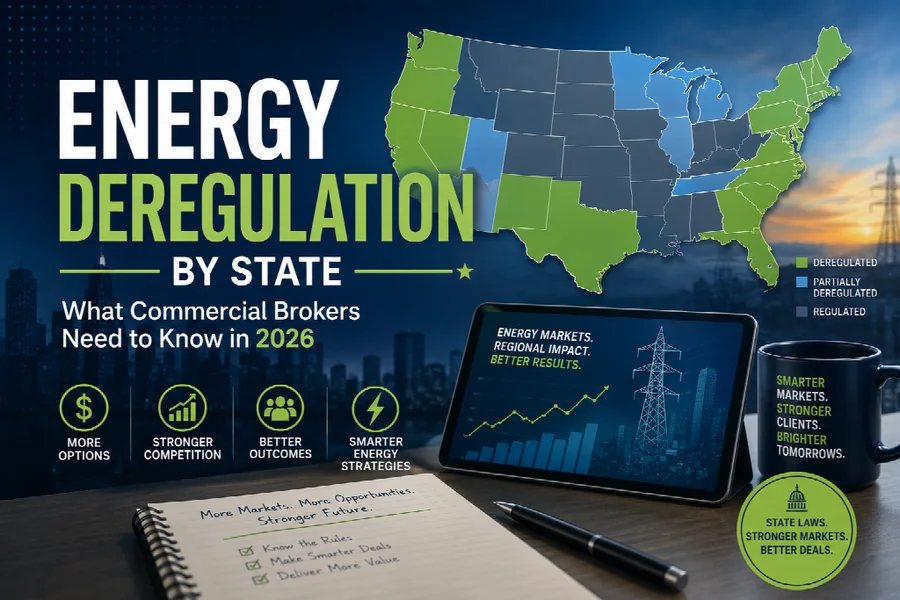
If you’re a commercial energy broker, where you focus your time matters just as much as how you sell. Not every state lets businesses shop around for their electricity or gas, and that one fact changes everything about where your leads should be coming from. Getting your head around deregulation, state by state, is honestly one of the biggest unlocks for growing a broker book.
Why Deregulation Even Matters
In a regulated state, a business gets its power from whatever utility serves that area, end of story. No negotiating, no shopping, no broker needed. But in a deregulated market, businesses can pick their own energy supplier, which means there’s actual room for a broker to add value by finding better rates, better terms, and better service than the default utility offer.
That’s the whole game. No deregulation, no marketplace, no commission. So if you’re spending time chasing leads in a regulated state, you’re basically fishing in a pond with no fish.
The Big Deregulated Markets Brokers Should Know
Texas is probably the one everyone thinks of first, and for good reason. ERCOT runs its own grid, mostly separate from the rest of the country, and it’s about as open a market as you’ll find for commercial electricity. Lots of suppliers, lots of competition, lots of opportunity.
Then you’ve got the PJM footprint, which covers a huge chunk of the country, states like Pennsylvania, Ohio, Illinois, New Jersey, Maryland, and a handful of others. These markets work a bit differently from ERCOT since they sit inside a bigger regional grid, but they’re still wide open for brokers to bring value.
New York and the New England states (Massachusetts, Connecticut, Rhode Island, Maine, and so on) round out most of the rest of the deregulated map. Each one’s got its own quirks, so it pays to know the local rules before you start pitching.
It’s Not Just About Electricity
A lot of brokers get so focused on electricity that they forget natural gas deregulation is its own thing, and in some states, it’s actually more open than the electricity side. Ohio, for example, has a pretty mature gas choice market. If you’re only pitching electricity, you might be leaving money on the table with clients who’d happily switch gas suppliers too.
What This Means for Where You Spend Your Time
Knowing the map is one thing, but using it is another. Once you know which states are actually open for business, you can start being a lot more intentional about where you’re spending your marketing dollars, who you’re prospecting, and which verticals you’re targeting in each state.
A broker running campaigns in a regulated state is basically wasting effort. A broker who knows exactly which states, which utility territories, and which fuel types are open is going to close a whole lot more deals with a whole lot less wasted effort. This is exactly the kind of edge a solid energy broker solution is built to give you.
Using Tech to Stay on Top of It All
Deregulation rules aren’t set in stone forever, either. States adjust their rules, utilities change their territories, and new markets open up (or occasionally close). Trying to track all that by memory or in a spreadsheet gets old fast.
This is where having a solidenergy broker platform really earns its keep. With the right software, you can see supplier availability by territory in real time, so you’re never guessing whether a lead is even sellable. That means less time wasted on dead-end prospects and more time closing the deals that are actually there to be closed.
The Bottom Line
Deregulation is the foundation everything else in this business is built on. Know the states, know the fuel types, and know the utility territories before you build your prospecting list. Get that part right, and everything downstream, your marketing, your sales calls, your close rate, gets a whole lot easier. Pairing that knowledge with reliable energy broker software is what turns a good broker into a top performer.
